After
a year of staying close to home and seeing only a few friends, we were climbing
the walls and ready to roll. So, after our second shots, we planned a looping
drive that took us from the Oregon
Coast to the Grand Coulee
Dam and from rain and wind, to snow and fog, and to bright sunlight.
Almost
every trip that finds us heading to the coast includes riding the ferry across
the Columbia at Westport, Oregon.
It’s a 10-minute ride on a ferry that holds about 15 cars. It ends up in
Cathlamet, Washington, where, in the interest of stimulating the economy, we chowed down at
Patty Cakes Café. (Salmon Panini highly recommended).
Then
it was on to Dismal Nitch.
Since it plays a small but crucial role in Mike's new book Angus McHaggis and the Bashful Sasquatch, he insisted on stopping there.

Lewis
and Clark were pinned down there for five days, waiting out wind and
high waves
and dodging stones brought down by torrential rains. Was it a stroke of
irony
that the visitors’ center was closed and we couldn’t get to the actual
nitch? We pondered that in our room overlooking the Astoria Bridge.
Heavy
rain abated overnight, but showers continued, the temperature hovered in the
high 40s and the wind picked up. Depoe
Bay was packed with
spring breakers in shorts and sandals. We strolled past them in our layers and
waterproof jackets, eyeing the breaking waves and rising swells.
Were we
relieved to find our whale-watching excursion was cancelled? We’ll let you
decide.
Later,
on the beach at Newport,
we discovered a “gift” from the waves, a huge orange fishing net float.
Mike
also discovered some world-class crab cakes and potato salad. If you find yourself in Newport, treat yourself to a meal at Georgies.
In
the
morning, it was on to Bend.
The storm that cancelled our boat trip had dropped snow in the
mountains, but
the sky was clear and the road was mostly plowed and slick in only a few
spots.
There were great views of the mountains including the Sisters and the
peak below. Little did we know this was a training run for a later drive
through another
pass.
 |
Three Finger Jack
|
The
next day we headed for Baker
City through the John Day
Fossil Beds. Unless you prefer the canyons formed by tall buildings, this is
fascinating terrain with rock formations in a range of colors that vary in
intensity depending on the light.
At
Baker City
we visited the city’s impressive historical museum and then headed for
the Snake River through amazing canyons. Unfortunately, snow
squalls blew in and, after a review of the meaning of mortality, we
turned back
and checked in at the Geiser Grand Hotel. http://www.geisergrand.com/
It’s
a regular destination for ghost hunters and stories abound, but we
didn’t
see a single wisp or shimmer, and we didn’t hear things go bump in the
night. Although the chandelier above Carolyn's bed swayed, We're pretty
sure that was due to
air from a nearby heat vent. But, maybe not.
If
you’ve never been to Baker
City, consider putting it
on your bucket list. Where else can you find statues of baboons on roofs, an alligator
crawling down a wall, ostriches and camels and a sculpture inspired by salt
licks?

An
inch of snow lay on the ground, but we told ourselves the storm would blow through
and headed for Joseph and views of the Wallowa Mountains.
The view mostly was obscured by snow and by the time we reached Joseph it was
piling up, laying four inches on statues along the main street.
Again,
we turned back, making a quick stop at a delightful small library in Wallowa.
We were overjoyed to be allowed in and to be able to touch books not delivered
curbside in a paper bag.
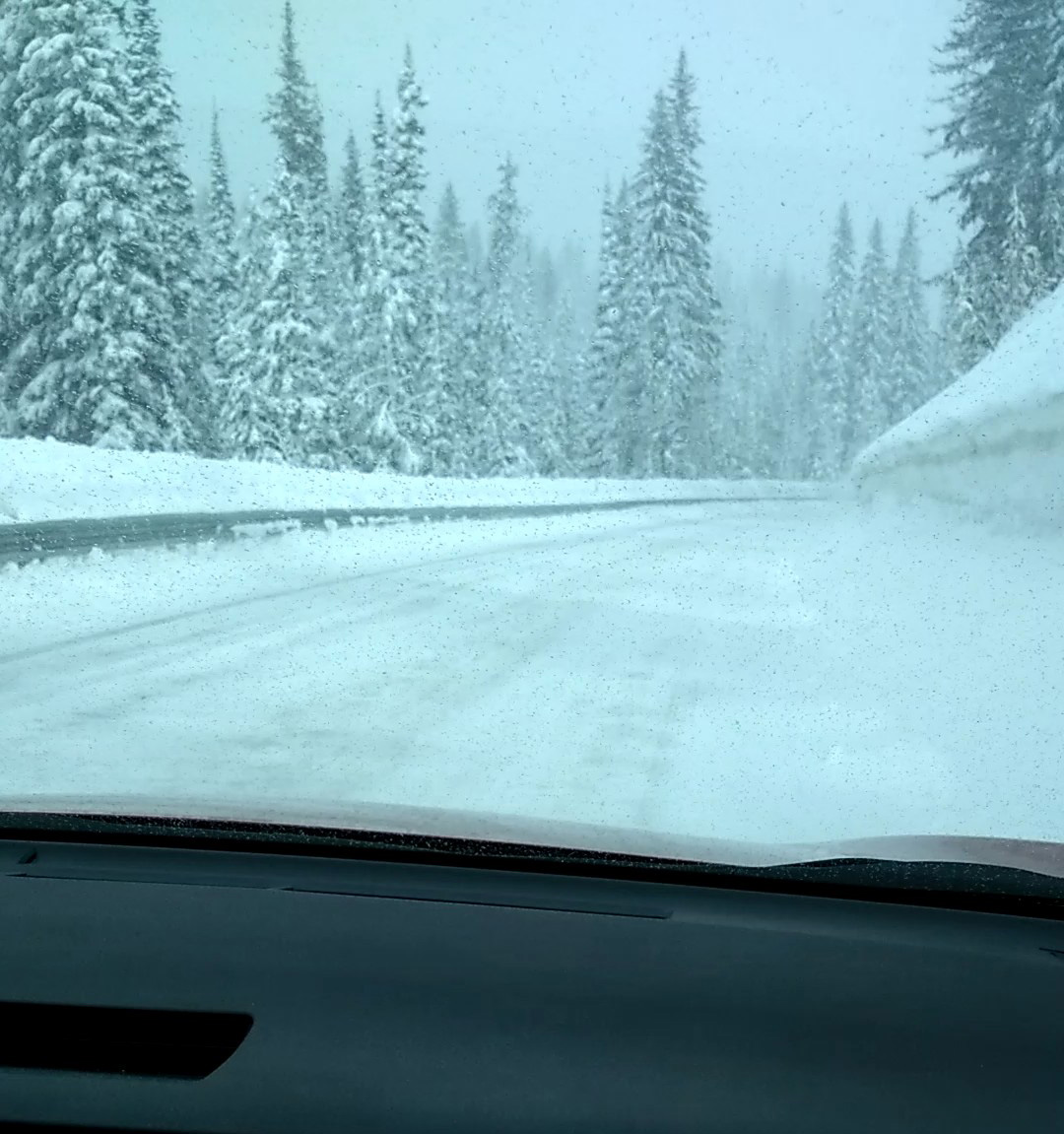
At Elgin, we decided to go for 204 to Weston and then on to Walla Walla. After about
15 miles we encountered snow but this time we forged on—partly because turning
back would have added many miles to our trip, but mostly because looming snow
banks hemmed us in and narrowed the road so that turning would require several
moves and put us at risk of being slammed by traffic coming the other way. Near
the top of the pass, fog closed in and visibility dropped so much that it was
difficult to see more than 50 feet ahead.
It was nerve wracking, but you know
we made it because Carolyn is writing this. Mike's note here. Carolyn has forever earned her title of "W.P. D. I. C."
For the uninitiated that's "Winter Pilot Directly In Charge."
If
you
love wine, Walla Walla
is a good place to stay. If you’re not a wine lover, it’s still a fine
small
city and many of the shops and restaurants were open for business in
some form.Plus there were some interesting sculptures. You can try to
figure this one out. We couldn't.
Thriving
was not a word we'd use to describe many of the small towns we passed
through on our way to Dry Falls
and Grand Coulee Dam. We saw clear evidence of the wreckage left by
closures
and economic hardship—businesses closed not just for the season but
forever,
and a general air of weariness, frustration, and futility. Few cafes
were open
and many restrooms were locked. When we reached the dam and found the
visitors’
center shut down, the joy of road-tripping faded in a serious way. But
still, the dam was something Mike vowed to see in his lifetime and he
got his wish. He claims he could hear Woodie Guthrie singing This Land is Your Land as he peered out at the immense structure.
We
headed for Wenatchee
and, by accident because we don’t possess a GPS and were without a map, settled
in a hotel with a great view of the river. And we reached the point where, even
though there were miles to go and a few things we wanted to see, the trip was
over.
Well,
nearly over. Because there were still the rolling hills around Goldendale to
see—hills where wind turbines stalked the crests, spinning with the steady
current of air coming down the Columbia Gorge.
And there was still Stonehenge to admire.
Okay, it’s only a replica, but the
setting at the edge of the drop to the Columbia
is stunning. The shadows cast by a sun a week past the equinox were stark, and
those shadows indicated it was time to be home again.


 Sometimes it’s
just a bit, like the water pouring from the dipper held by the cowgirl bathing
in a washtub, or the shades of green on the leaves nailed up around the
branches of a metal tree.