Showing posts with label aging. Show all posts

Monday, April 11, 2022

That’s Zit


Carolyn J. Rose


How old do you need to be before you stop getting zits?


The answer, at least in my case, is: “Older than a post-retirement age I’d prefer not to mention.” To customize an old top-40 radio slogan, the zits just keep coming.


On the positive side, the zits erupting lately aren’t in the same league as those that made my teen years miserable. (Okay, for the record, my no-one-understands-me attitude and general teenage snarkiness also contributed to self-imposed misery, but zits didn’t help.) The zits I get at this age aren’t nearly as large or as bright. And they don’t bring along a crop of friends. But still, despite facial scrubs and special creams, fresh air and healthy foods, they come.


Back in those teen years I grew out my bangs to cover platoons of pimples on my forehead. I kept my hair shoulder-length and never shoved it behind my ears because that would reveal lurking zits. I tucked my chin into turtleneck sweaters or scarves.


But zits are like lies—they’re often difficult to cover up. Especially when they erupt in extremely visible places.


And zits are extroverts. They love to pop up at special events. They never miss the opportunity to show up for a hot date, an important job interview, a conference presentation, or a wedding.


A particularly pointy one, the color of a ripe tomato, appeared on the tip of my nose on the morning of a friend’s aisle walk in the 60s. My bridesmaid’s dress was bright green and included a wide hair ribbon to match. The contrast in colors made the blemish more obvious.


Now, trust me, there are places on your face where you can apply a thick layer of zit-hiding cream and it will stick because the skin is smooth and dry. And there are places where the facial terrain is pitted, creased, wrinkled, or oily, and those skin-toned creams crack, clump, or slide off.


There are instances where hot packs can speed up the progress of zit, or cold packs can slow it. And there are instances where taking a drastic step and popping a pimple can mitigate the problem. But, trust me once again, the zit has to cooperate. It has to be ready to give up. And that one wasn’t.


As the hour approached, the zit swelled until it felt like I’d taken possession of Pinocchio’s lie-activated wooden nose and spent the day claiming to like beets and Richard Nixon. When it was my turn to walk down the aisle, I felt like that little reindeer guiding Santa’s sleigh through the fog.


I destroyed my copies of the wedding photos the moment they arrived. But memories of that day, like zits, keep popping up.


Monday, February 16, 2015

Watching Bubba Age

Carolyn J. Rose 


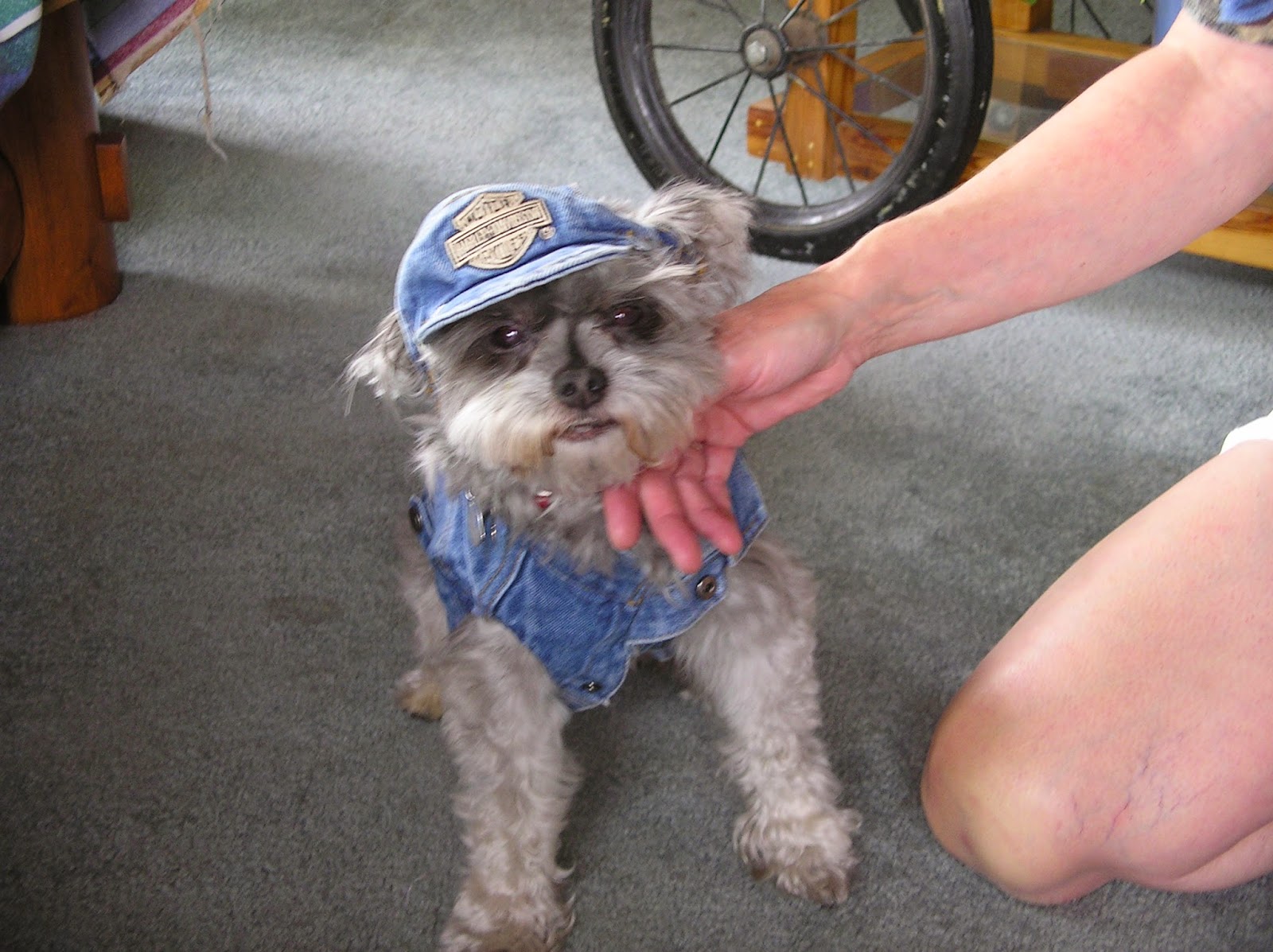
In 2000, I spotted a small gray dog on the TV news segment designed to match potential owners with pets from the local Humane Society. She looked right into the camera and right into my heart. I raced down to Mike’s office yelling, “Get in the car. We’re going to get a dog.”

We’d been three months without a canine companion at that point, and he was at least half as ready as I was. In a few minutes we were in the car and within an hour I was holding Belle. Her owner had died and the family didn’t want her.

Too bad for them! They missed out on a lot of years of love and devotion, friendship and fun.


After taking care of the paperwork, Mike and I hustled her off to a pet supply store for a collar, tag, toys, food, and other paraphernalia. We hustled her to the vet for a check-up and shots. We hustled her around to show our friends. We were, looking back on it all, ridiculously besotted with her.


She was eight pounds of feisty attitude back then, and clearly not a Belle. Mike took the pink ribbon out of her hair and gave her a new name—Bubba. She grew into it, becoming a ten-pound alpha who arranged the days to meet a schedule firmly embedded in her tiny brain. Always fair, she moved from lap to lap, room to room, checking on us, herding us toward the leash hanging by the door, informing us it was time for breakfast or dinner.

She’s 15 now and often we’re the ones who herd her—waving our arms so she’ll see movement, clapping our hands so she’ll hear. She still informs us when it’s time to eat, but mostly she sleeps, curled in a special cushion in my office, snuggled on the sofa beside Mike, or wedged between the pillows on our bed.

Someday she may not wake up when I pet her head or put a dog biscuit under her nose. I hope that’s how it will happen. I hope she knows it’s time to leave and makes the decision herself. I hope she will go off in her dreams to explore whatever comes next for a devoted dog who always knew her own mind.

Tuesday, December 23, 2014

Crinkly? Really?


Carolyn J. Rose

Recently Mike and I were privileged to spend 24 hours with our five-year-old friend Tristan Stone.

That’s when we discovered that we’re crinkly.

Like most kids, Tristan sometimes seems older and sometimes younger than his age. He sleeps with a stuffed lamb and needs a little help brushing his teeth. Later he reminds Mike to wash his hands and tells us we should drink plenty of fluids before we go to the pool.

That’s where we found out we’re crinkly.

Tristan informed us he could swim by himself all over the pool. Visualizing his parents drawing and quartering me if anything happened, I made the case for staying in the shallow end. I made another case for one of us being by his side at all times, claiming the lifeguards would throw us out if we weren’t.

Tristan agreed, but told me he wouldn’t need me because he was a better swimmer. “I’m young and like a monkey and my skin is smooth. You might sink because you’re all crinkly.”

“Crinkly?”

“Yeah.” He pointed. “Especially around your eyes.”

I refrained from the snappy comebacks I employed when I was a kid, world-class insults like: “Your mother wears combat boots.” or “Your father voted for Nixon.” I also refrained from sticking out my tongue because that would only create more crinkles.

After all, Tristan was just stating the obvious. Like it or not, I’m 67. And I’m crinkly.

Wednesday, August 13, 2014

Going Gray III


By Carolyn J. Rose


The long journey into gray is nearly over.

A year ago I sucked it up and made the decision to stop coloring my hair.

The first few months—and inches—were the hardest, especially since I decided to let go and let it grow without benefit of rinses to cover the roots during the process.

Every time I looked in the mirror I had second thoughts. Every time I caught women at the pool staring, I waffled. Several times I almost dialed the salon to beg my hairdresser for forgiveness and plead for her to take me back.

But then came the day when the last bit of color was out of my bangs and I spotted a swath of silvery gray. I tell myself it adds character. And, let’s be brutally honest, it will ensure that I get a senior discount if I don’t happen to have my driver’s license as proof of age.

Sunday, December 8, 2013

Going Gray – Part II

August 29, 2013

 Carolyn J. Rose
 
December 8, 2013
"It’s not bad now,” my hairdresser said as she trimmed off split ends a few weeks ago, “but it’s going to get scary when you have more gray showing.”

Scary?


Since my decision to stop coloring my hair cut into her income, I didn’t expect her to applaud and cheer me along.


But scary?


I found myself tipping my head to get a better view of the process underway since the end of the summer. Yes, there’s a definite line of demarcation. Yes, it’s obvious I haven’t been touching up the roots. Yes, it’s clear that there are strands and streaks of gray and even white.


But is that scary?


And if so, why?


Because we fear aging, fear the wrinkles and sagging and graying? Do we see those things not as symbols of wisdom and experience, but simply signs that time is passing and we’re no longer young?


If so, is that fear rooted in opinions about outward appearance? Is it based on what the makers of cosmetics and creams and diets and exercise programs tell us?


Or is the fear deeper, primal, coded into our DNA? Is it a fear of loss of ability and power and place in society? Is it fear about what comes next?


I have no idea. Do you?

Friday, August 30, 2013

AN END TO THE COVER-UP


Carolyn J. Rose

Twenty years ago I passed in front of a mirror in a poorly lit room and saw my mother.

Actually, I saw myself, but in the dim light with short mousy brown hair sprinkled with gray and a blouse resembling one she owned, the resemblance was uncanny.

The next day I streaked my hair and vowed to let it grow.

Don’t get me wrong, my mother was an attractive woman and I admired her. But my gut reaction was that I was too young to look like that—“like that” meaning “old.”

Now I’m about the age she was when I glanced into that mirror. My husband’s hair and beard are gray-white and the wrinkles in my face are telling me I’m not kidding anyone—least of all myself—with the golden-brown dye job I have now. It’s time to stop the cover-up.
 I tried out the idea on some friends at the pool—some a little older and some a little younger. Comments ranged from “You seem to have lots of silvery white in there so I think it will look good” to “It’s your life” to “You can’t. You’ll look so old.”

My response? I am old. I’m started-on-Medicare-last-year old. Old enough that I don’t need to explain or defend a decision as minor as this.

Still, after two decades of dyeing, going gray won’t be easy. And it won’t be pretty. There will be growing pains. There will be moments when I reach for the phone to dial my hairdresser. There may even be tears.

But if I avoid mirrors, I think I can make it.

Root for me.
(Pun intended.)

Sunday, June 30, 2013

Notes from the trail


Important lessons learned on the Rogue River Trail.

When you reach my age (64 and closing in fast on 65), you tend to dream up things to do to prove to yourself you’re not really getting old. Many of which are: (a) unrealistic, (b) delusional, (c) potentially fatal (d) not even things you could have accomplished when you were young.

My original plan for the summer involved walking the length of the Oregon Coast Trail, some 360 miles, camping along the way and seeking spiritual enlightenment. This plan ran into some immediate problems, the first of which was my inability to interest anyone else to tackle this project with me. Responses ranged from: “you must be high,” to “sounds great, can I have your golf clubs?” to “you wouldn’t know spiritual enlightenment if it jumped up and bit you in the yin or yang.” Okay then, perhaps it was time to try plan B.


My son Rob, who initially thought he might come along on the Oregon Coast Walk (I think he decided someone needed to be on the trip who knew CPR), suggested we scale back a skosh.  After some palavering (like negotiation done while hunkering), we decided to take a week, jet boat up the Rogue River and hike, camp, and fish our way along the trail. I jumped at the idea—a chance to reconnect with my son, eat freshly caught trout and sing campfire songs (turns out neither of us knew the words to Kumbaya). What’s not to like? Plus, if I could get spiritually enlightened in three weeks, I could be 1/3 enlightened in a week, right? 

It was a great experience, one I would recommend to anyone who wants to spend time away from cell phones, television, people and light pollution. The scenery is eye-popping, the air is clean and it’s amazing how you can learn to love food that only requires adding boiling water. Here are lessons learned and more pictures. 

Lesson #1.  The jet boat up the Rogue River can transform otherwise mature adults into a giggling, gasping, gaping 3rd-grade class. I’ve never heard so many grownups scream whee!!!in my life. Here we are admiring turkey-buzzards snacking on a dead sturgeon. 
Not a big  fan of carrion? We also saw ospreys, eagles, deer, otters, river seals and the occasional dinosaur. 


 Lesson #2.  Hauling a 40 pound pack up a rocky trail is hard damn work. I’m reasonably fit, but damn. Schlepping a backpack 360 miles for 3 weeks? My initial critics were right, I must have been high. We didn’t hike any killer distances.
The two camps we stayed at were between a mile and two and a half miles away from the lodge where we caught the boat home. .  


 Lesson #3.  If you’re going to wash your clothing in a fast-moving creek, be sure to grip it tightly. Some lucky rafter is now the proud owner of a pair of 38-30 cargo pants that descended from heaven via a stream-fed waterfall.


Lesson #4.   You learn amazing things about people you’ve known all of your life when you camp with them. 
I learned that my son, who never picked anyting up off the floor in all the years I lived with him is an accomplished and conscientious outdoorsman. 

He can light a campfire with wet wood in a torrential rainstorm, pitch a tent like a pro (is there a league for that?), and identify all kindsof plants and animals. 


For example, he knew instantly that this was a deer. I was under the impression it was some kind of horned fungus.

 He also insisted we leave our campsites cleaner than we found them. Who knew the kid who grew accidental biology experiments under his bed would be so tidy?

Lesson #5.  Sodden is an entirely descriptive word for a certain state of being. It rained hard for one day and most of another. When I awoke on Wednesday morning, everything I had with me was saturated. I was ready to break camp, hike to the lodge and thumb a ride back on the jet boat. Rob calmly spent an hour and a half starting a fire, making us coffee and telling dad to mellow out. 
Lesson #6.  Nobody likes a hardhead. Thursday morning Rob even allowed as he could be convinced to go hole up at Paradise Lodge for the final night. The tipping point was the realization that we were out of coffee and would face a decaffeinated scramble to catch the boat on Friday after breaking camp. Both of us craved a shower, a meal someone else prepared and drinking a beer (or eight) on the deck and watching the rafters float by. Sleeping on a real bed after 4 nights on rocks and dirt? Near orgasmic. I recommend this place. It’s a tad spendy but includes meals. And the view is phenomenal.
Final and best lesson.  I may joke about it, but there certainly was an element of spiritual enlightenment in my trip up the Rogue River. Even as an agnostic, I felt a level of inner harmony and peace that seems impossible to accomplish in the confines of a city. You look at the sheer cliffs, magnificent trees, abundant wildlife and star-packed skies and wonder whose plan this might have been. 


Thursday, April 11, 2013

Risky Business

BETTER SORRY THAN SAFE

Mike Nettleton 


         I started thinking about the concept of risk the other day after my 66-year old best friend Michael confided that he’d signed up for Scuba-diving lessons. Apparently, strapping on oxygen tanks and exploring the murky depths, had been a life-long dream; he was damned if he was going to let his heart issues and age stop him from fulfilling it.
         As a realist, who jokes he is a “drowner” as opposed to a “swimmer,” this sound like insanely risky behavior. (Keep in mind I never did earn my YMCA “porpoise” credentials as an 8-year old, settling instead for a certificate that labeled me “algae.”) I’m exaggerating, of course. If I capsized in the ocean, I’m confident I could survive. The strategy is simple; find the nearest person who knows what they’re doing and hold on for dear life.
         Our earliest recollections may include parental reminders to avoid questionable behavior at different ages and stages of our life.
          “Don’t touch the hot stove, you’ll burn your hand!”
          “Stay away from that boy, he’s got trouble written all over him!”
          “Invest in a company that makes running shoes? That's crazy talk!"
         When we become adults, (I’m still waiting for my certification) many of us continue to practice risk avoidance—settling into safe jobs, safe marriages, safe hobbies.
         But, reflecting on my past, much of what has been the most gratifying involved taking chances. Not putting myself in physical peril so much, as I have no desire to jump out of a perfectly good airplane, rattlesnake wrangle or spelunk. In my case, risk has involved making life decisions that left a major question hanging in the air. “What’s going to happen now?”
         I once took a morning show job in radio without having met the people I was going to work for. In fact, my job interview and acceptance consisted of a recommendation from a friend of mine and a five-minute conversation with the general manager.
         Shortly after, I found myself schlepping across the southwest part of America pulling U-haul trailer behind a skeptical (and shoddily made) Mazda. Neither my future-former wife or I had any clue what to expect from Albuquerque. In fact we had to stop in Flagstaff, Arizona and ask if, perhaps, we’d already driven past it and hadn’t noticed. And yet . . . yet . . .my dozen or so years in New Mexico proved to be some of the richest, most rewarding and memorable times of my life.
         As writers, we know all about putting ourselves on the line. After all, that manuscript you’ve toiled over for months (if not years) runs the constant risk of ridicule and disdain. That carefully crafted simile, as graceful as a wet dachshund, could easily provoke a reader to say or think; “That sucks like a nuclear-powered vacuum cleaner.” Yet, all it takes is for one reader to tell us she enjoyed reading our work and looks forward to the next, to make the negativity swirl down the drain—forgotten.
         In my retirement years, I’ve begun thespianizing again. (If it’s not a word, it should be). I acted (and acted out) regularly during my college and post-college days. The first post-retirement foray, two summers ago, was with Portland Actor’s Ensemble, a company that performs free Shakespeare in the city parks during the summer. We coped with traffic noise, barking dogs, car alarms, boisterous street punks and a drunk who, to paraphrase Janis Joplin: pulled his harpoon out of his dirty red bandana. This cretin wailed out harmonica blues riffs during my best speech in the The Tempest. We had to incorporate him into the on-stage action. The adrenaline generated by terror and generous audience applause during the curtain-calls left me feeling alive, relevant and craving another chance to entertain.
         Most recently, I’ve gotten involved with The Original Practice Shakespeare Company. These maniacs perform the Bard’s work faithful to techniques used n the 16th and early 17th century: no director; no rehearsal; scripts-on-a-scroll that only include your lines and the cue line before yours. Your tools as an actor are your interpretation of what’s going on, based on the words on the page, the actions of the other characters and whatever costuming and props you choose to bring with you. You’re encourage to include the audience in your antics. Act one, scene one, you’re on your own, go for it. Trust me, performing this way is undiluted fear of the most delicious variety.
         Now this endeavor is certainly not an equivalent risk to being lowered into the Mariana’s trench in a shark cage or schussing down the sheer face of various and sundry Alps, but it does share some characteristics. There is that moment, when you step forward and launch yourself into the abyss of unknown outcome that makes you appreciate the fullness of life and your potential as a human being.
         Leaving your own comfort zone, and pushing the limits of what you believe you’re capable of, is one way to reaffirm that you’re alive. Whether your risk-taking involves roller-blading blindfolded and nude through a busy airport or simply writing a haiku and posting it on the internet, I encourage you to go for it. Try something you’ve always wanted to try. Take a class on a subject matter that baffles and excites you. Risk ridicule by performing, painting, playing music or dancing. Tell the waiter at an authentic Chinese restaurant to bring you something exotic.
         Are there consequences for risky behavior? Sure there are. What you have to weigh is whether those repercussions are worse than knowing that fear kept you from living your life to it’s fullest potential.